Organic Music Growth · 9 min read ·
How to Build a Music Content Machine Like a Record Label
Create a solo-artist content operating system that turns every song into a library of videos, distributes them across channels, and improves with audience feedback.
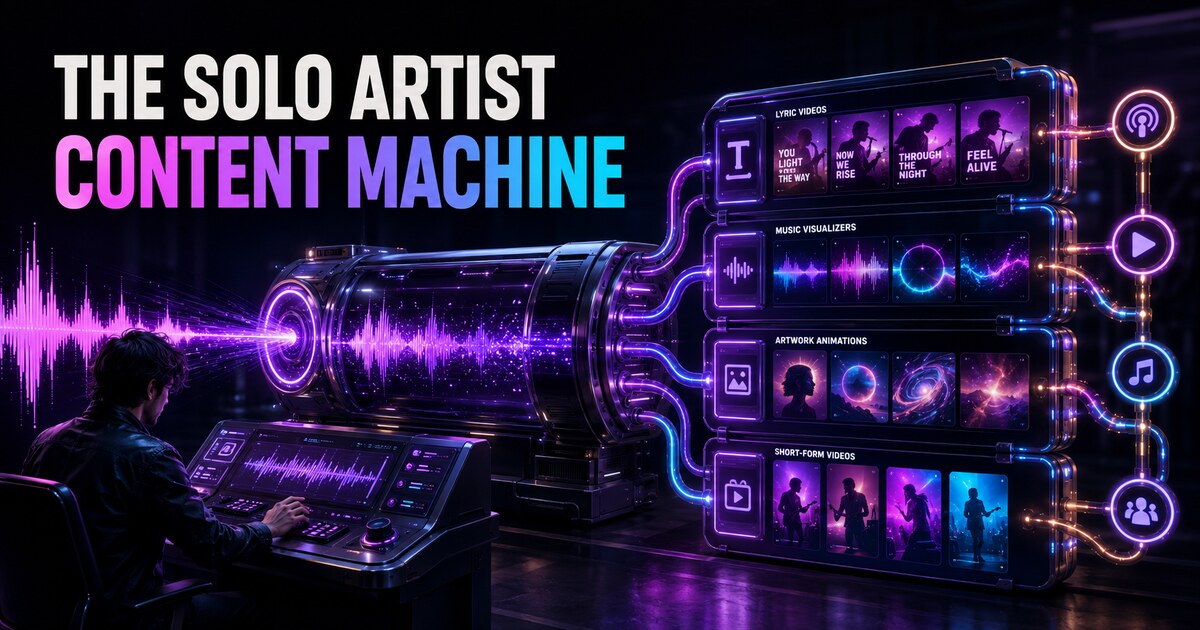
A record label does not promote a release by making one post and hoping. It builds a campaign: creative assets, multiple angles, a distribution schedule, audience feedback, and follow-up content.
An independent artist can use the same operating logic without copying the label’s headcount or budget. The goal is a music content machine: a repeatable system that turns each song into a useful library of videos and learns from every post.
This is not content spam. A machine should increase useful variation, not duplicate the same clip endlessly. It should protect your creative energy so you can spend more time making music and less time rebuilding exports.
The five jobs inside a label-style content system
Even if one person performs every role, separating the jobs makes the workflow easier to manage.
1. The strategist chooses the campaign angle
Write one sentence that explains why a listener should care about this song now. It might be the story behind a lyric, the feeling the chorus captures, the production detail that changes the mood, or the community the track belongs to.
A vague goal such as “promote my single” produces vague content. A precise angle creates direction: “This is the late-night song for someone trying not to text their ex” gives you language, imagery, hooks, and audience context.
2. The archivist organizes the source assets
Create one folder or workspace for the release:
- Final audio and clean excerpts
- Lyrics with important lines marked
- Cover art and alternate crops
- Artist photos or performance footage
- Visual references, colors, and type choices
- Release link and calls to action
- Notes about the song’s story
This becomes the source of truth. You stop searching through camera rolls and old exports every time you need a post.
3. The producer creates variations
Turn the source assets into several types of vertical video:
- Beat-synced lyric clips
- Animated artwork
- Audio visualizers
- Mood loops
- Short process or story clips
- Alternate hooks using the same visual language
TrackPush helps here by letting you reuse themes and generate multiple music-video assets without building each one manually. Start with the bulk music-promo video guide if your current bottleneck is production volume.
4. The distributor adapts and publishes
The distributor decides where each asset fits. A strong 9:16 video can move across TikTok, Reels, and Shorts, but the caption, cover, title, and publishing time may change.
Think “one idea, channel-aware packaging,” not “three completely separate content calendars.” The multi-account music-content guide gives you a practical repurposing structure.
5. The analyst closes the loop
At the end of each week, compare results and decide what to repeat. The analyst is not judging whether the song is good. The analyst is evaluating whether the presentation helped the right listener understand it.
Review:
- First seconds and average watch behavior
- Replays and completions
- Saves and shares
- Profile visits and follows
- Comments with specific emotional or lyrical responses
- Clicks or streaming movement after a post
For a deeper framework, use organic music-promotion metrics that actually matter.
Build a hook library before making videos
A content machine begins with raw material. For one song, collect at least ten hooks across four categories.
Lyric hooks: lines that create tension, recognition, surprise, or a strong image.
Story hooks: why you wrote the song, what nearly stopped it from being released, or what changed during production.
Audience hooks: a question or situation that helps the right listener identify themselves.
Sound hooks: a beat switch, vocal entrance, instrumental detail, or chorus payoff.
Do not force every hook into a talking-head format. A lyric can appear as typography. A story can be written over artwork. A production detail can be shown through a visualizer or screen recording.
The short-form hook selection guide will help you choose song moments that work without a long setup.
Use a three-layer template system
Labels reuse campaign systems while changing the creative. You can do the same with three layers:
- Brand layer: fonts, logo treatment, core colors, and overall visual character.
- Song layer: artwork, palette, lyrics, and mood for the current release.
- Post layer: the specific hook, opening frame, animation, caption, and call to action.
The brand layer creates recognition. The song layer creates a coherent campaign. The post layer creates enough variation to learn.
TrackPush themes are most useful when they support these layers. Choose two or three visual treatments per release rather than using every style available. Consistency makes the campaign feel intentional; variation gives the platforms and audience fresh entry points.
Plan a 30-asset release library
Thirty assets do not require thirty unrelated concepts. One possible library is:
- 10 lyric-hook videos
- 6 animated artwork variations
- 4 music visualizers using different song moments
- 4 story or context posts
- 3 process clips
- 3 direct calls to hear, save, or respond to the song
You do not have to publish all 30. The library gives you options. Publish a small first wave, observe results, then prioritize the most promising material.
If producing this volume feels impossible, turn one song into 30 TikToks, Reels, and Shorts breaks down the batching process.
Run the machine in weekly sprints
A sustainable sprint might look like this:
Monday — select: Choose four hooks and two visual directions.
Tuesday — generate: Create and export a batch in TrackPush.
Wednesday — package: Add opening text, covers, captions, titles, and links.
Thursday through Sunday — distribute: Publish, reply, and note qualitative reactions.
Sunday — review: Mark each concept as repeat, revise, or retire.
A board with five columns is enough: ideas, selected, produced, scheduled, reviewed. Each asset should include its song moment, format, channel, date, and result.
Avoid the machine’s three failure modes
Volume without distinction
Uploading the identical clip repeatedly can train your audience to ignore it. Change the hook, visual treatment, context, or audience promise.
Automation without humanity
People connect to meaning, taste, and interaction. Use production tools to remove repetitive labor, then spend the saved time answering comments, participating in scenes, collaborating, and developing your story.
Measurement without patience
A few posts are not enough to establish a pattern. Compare groups of related tests, and do not change every variable at once. If you alter the song moment, visual, caption, and channel simultaneously, you will not know what helped.
A machine for artists who do not want to be influencers
The system does not require constant access to your private life. You can build around lyrics, artwork, animation, performance fragments, visualizers, and written stories. The guide to promoting music without showing your face provides a complete face-optional format library.
It also does not require an ad budget. For a cold start, how to promote music with no fans and no budget explains how to create your first discovery and community signals.
The smallest viable label machine
Start with one release, two visual themes, six hooks, and three channels. Produce 12 assets, publish four in the first week, and let the results shape the next eight.
That is enough to establish the operating loop:
song assets → creative variations → distribution → listener signals → better variations
TrackPush supports the production and reuse stages. Your taste guides the creative. Your conversations build the relationship. Your analytics help choose the next move.
For the full growth strategy surrounding this system, read how to grow as an independent artist without paid ads.
Put the system into practice
Start creating music-promotion videos with TrackPush and turn one song into a reusable set of assets for TikTok, Instagram Reels, YouTube Shorts, and the channels your audience actually uses.
A managed label-style content option
Artists who want the content-machine approach without operating it themselves can use the TrackPush Managed Campaign: one song, 100 lyric-video and visualizer edits, and organic publishing across selected connected accounts over 30 days for $49 one time.