Content Strategy · 7 min read ·
How to run 5 Social Media Accounts Without Running Out of Music Content
A practical content system for artists, producers, and creators managing multiple social media accounts without spending all day editing promo videos by hand.
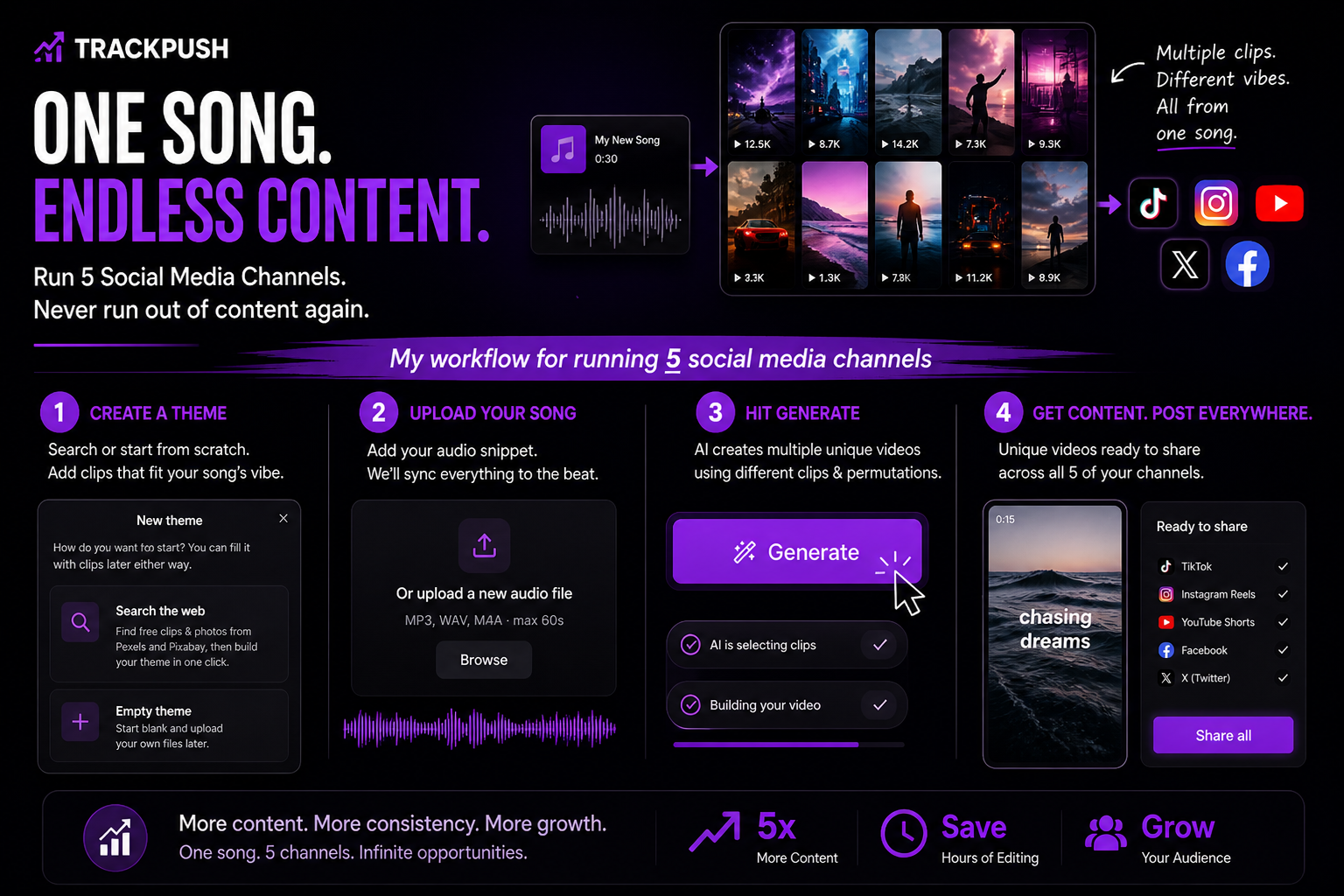
How I Run 5 Social Media Accounts Without Running Out of Music Content
Running one social media account is already a lot.
Running five is where things start getting messy fast.
For most artists, the problem is not posting. The problem is having enough content to post across multiple pages without burning out. You can have a good song, a strong snippet, and a real reason to promote it, but if you are trying to feed five different channels manually, the workload gets heavy fast.
That is where a repeatable system matters.
This is the approach I use to keep multiple social media accounts active without feeling like I need to edit content all day.
Why multiple accounts get hard so quickly
When you run five accounts, the pressure multiplies.
You are not just thinking about:
- what to post
- when to post
- which clip to use
You are also thinking about:
- how not to repeat yourself too much
- how to keep each page active
- how to make content variations feel fresh
- how to avoid spending hours editing every day
That is why most people eventually fall into one of two problems:
Problem 1: They stop posting consistently
The editing takes too long, so they miss days and lose momentum.
Problem 2: They recycle the same exact content everywhere
That is easier, but it also becomes stale fast.
The better strategy is to create a system where one song can generate enough content to support all your channels.
The real shift: one song should create many assets
If you are pushing a song, one clip is not enough.
One song should become:
- multiple videos
- multiple hooks
- multiple lyric angles
- multiple pacing styles
- multiple post variations
That is the only realistic way to support several pages at once.
Instead of treating each post like a brand new editing project, treat each song like a content source.
What I use across 5 accounts
The easiest structure is to give each account a slightly different purpose.
For example:
Account 1: Main artist page
This is where the cleanest and most direct promo goes.
Best for:
- out now posts
- strongest lyric content
- official-looking promo
- title and artist overlays
Account 2: Aesthetic or mood page
This is where the vibe-first content works.
Best for:
- visual edits
- atmospheric clips
- mood-driven snippets
- softer captions
Account 3: Fan-edit style page
This page should feel more organic and less branded.
Best for:
- relatable hook text
- fan-page energy
- emotional edits
- less formal promotion
Account 4: Genre-specific page
This page is for targeting a certain audience.
Examples:
- deep house
- Afro house
- sad pop
- rap edits
- producer content
Best for:
- genre hooks
- niche audience positioning
- “if you like this style…” posts
Account 5: High-volume testing page
This is where you can test more aggressively.
Best for:
- new hooks
- faster edits
- alternate snippets
- experiments
This structure makes it easier to reuse the same song without making every page feel identical.
The content system that makes this possible
The biggest mistake is trying to hand-edit every single version.
The better workflow is:
Step 1: Build a theme
Create a visual theme around the song.
That can include:
- aesthetic clips
- travel clips
- nightlife clips
- ocean clips
- city visuals
- phone-shot content
- lifestyle footage
The theme does not need to tell a literal story. It just needs to match the feeling of the song.
Step 2: Choose the snippet
Pick the part of the song that has the best chance of:
- stopping the scroll
- being replayed
- emotionally landing
- feeling catchy
Step 3: Generate multiple angles
Do not make one version. Make many.
Examples:
- teaser version
- lyric-led version
- fan-edit style version
- drop highlight
- direct out-now version
This is where the volume comes from.
Step 4: Distribute those variations across accounts
Instead of posting the exact same clip everywhere, each account gets a slightly different variation.
That way:
- the song stays consistent
- the content feels fresher
- the workload stays manageable
What changes across each account
To keep five accounts from feeling repetitive, vary:
- hook text
- lyric emphasis
- CTA strength
- pacing
- visual sequence
- caption tone
- promo mode
You are not making five completely different songs. You are making five different ways into the same song.
That is the key.
A simple weekly structure
If you are running five pages, a basic system could look like this:
Monday
Main artist page: strongest official promo
Tuesday
Mood page: aesthetic edit
Wednesday
Fan-edit page: emotional or relatable version
Thursday
Genre page: niche-targeted version
Friday
Testing page: alternate hook or faster cut version
That gives you daily output without needing totally unrelated content every single day.
Why this works better than manual editing
Manual editing breaks down when you scale because:
- it takes too long
- it is mentally exhausting
- it is hard to stay consistent
- it becomes harder to test different ideas
When you use a system that creates many versions from one song, you get:
- more content
- more consistency
- more experiments
- more surface area for discovery
That matters even more when you are managing multiple pages.
How TrackPush fits into this workflow
TrackPush is useful here because it helps turn:
- one song snippet
- one collection of visuals
- one theme
into multiple short-form promo videos quickly.
That means instead of editing every TikTok, Reel, or Short manually, you can generate a batch of unique variations and spread them across different social accounts.
For anyone managing multiple pages, that removes the biggest bottleneck: content volume.
Final thought
Running five social media accounts is not really a posting problem.
It is a content supply problem.
If one song only becomes one video, you run out fast.
If one song becomes ten, twenty, or thirty different promo angles, suddenly it becomes possible to stay active across multiple accounts without feeling buried in editing work.
That is the real advantage of a system like this.
More content. More consistency. Less burnout.