Organic Music Growth · 9 min read ·
Organic Music Promotion Metrics That Actually Matter
Learn which content and listener signals matter beyond views, how to diagnose weak posts, and how to improve each TrackPush video batch with evidence.
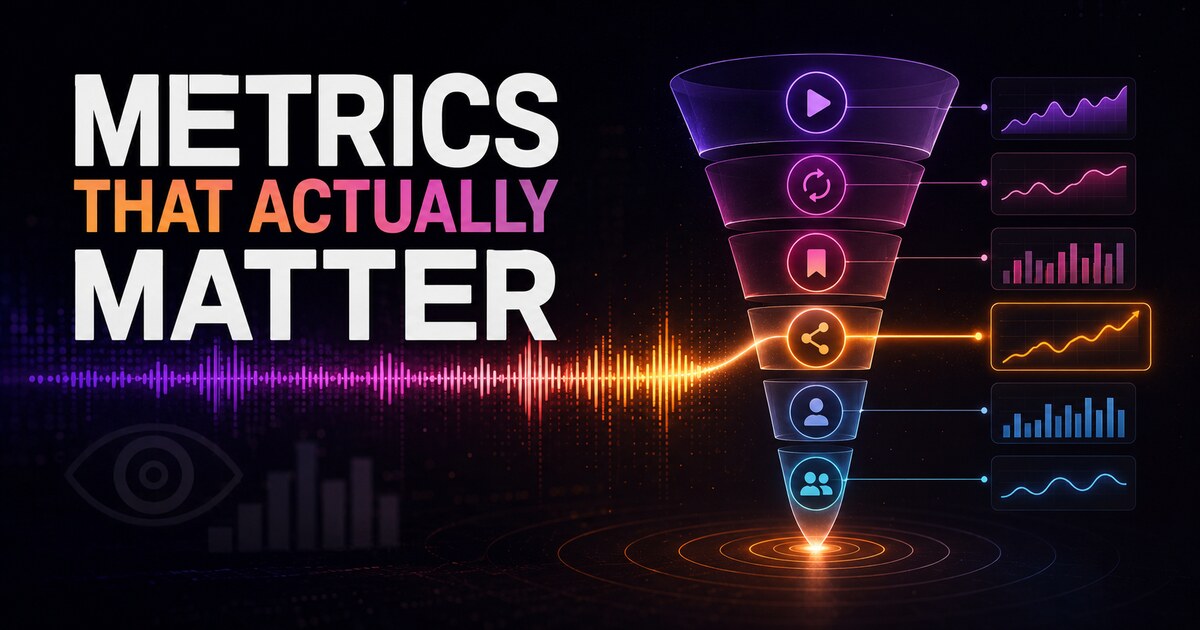
Organic music promotion becomes much easier to improve when you stop asking, “Did this post go viral?” and start asking, “What did this post teach me?”
Views are useful, but they are only the top of the funnel. A video can receive many impressions because the platform tested it, then create no lasting listener interest. Another clip can reach a smaller audience and generate replays, saves, profile visits, and comments that reveal a strong creative direction.
The purpose of measurement is not to turn art into a spreadsheet. It is to identify which presentation helps the right person connect with the song.
Measure the journey, not one number
Think about a listener moving through five stages:
- Stop: Did the opening earn attention?
- Stay: Did the viewer continue through the musical idea?
- Respond: Did they replay, save, share, like, or comment?
- Explore: Did they visit your profile or another post?
- Convert: Did they follow, click a music link, save the song, or return later?
Each stage answers a different question. If you track only views, you cannot see where the journey broke.
Stop metrics: did the opening work?
Platforms expose slightly different analytics, but early retention and average viewing behavior are the closest indicators of whether the opening frame, text, and audio earned attention.
When a clip loses people immediately, inspect:
- How quickly the music begins
- Whether the first line is readable
- Whether the visual looks intentional on a phone
- Whether the context is specific
- Whether the selected section has enough tension or payoff
- Whether the video begins before the interesting moment
Do not conclude that the song failed. First test a stronger entry into the song.
TrackPush makes this test practical: keep the song section constant and generate several opening treatments. The hook-selection guide can help you choose a better musical starting point.
Stay metrics: did the idea hold attention?
Completion rate, average watch time, and retention shape show whether the clip sustained interest. Interpret them relative to video length and format; a short loop and a longer story should not be compared as if they perform the same job.
Look for moments where viewers leave. The problem may be:
- A lyric screen remains static for too long
- The musical payoff arrives too late
- On-screen text asks for more reading time than the edit allows
- The visual becomes repetitive
- The video delivers the promised idea, then continues without purpose
Replays can be especially meaningful for music. They may signal that a lyric, melody, visual loop, or production detail rewarded another listen.
Response metrics: did someone care enough to act?
Different actions suggest different types of interest.
Likes are lightweight approval. Useful, but easy to give.
Comments become more informative when they reference a lyric, feeling, genre, story, or sound. Generic comments can be pleasant without telling you much about connection.
Saves may indicate that someone wants to return. For educational posts, the information might drive the save; for a song clip, the music or feeling may be the reason.
Shares suggest that the viewer associated the post with another person or community. That can be a strong sign of resonance.
Do not combine every response into one mystery “engagement rate.” Read the pattern. A high-save tutorial and a high-replay lyric video may both work, but for different reasons.
Explore metrics: did the post build artist interest?
Profile visits show that the clip created curiosity beyond the individual post. Compare profile visits with follows and link actions.
If a video earns strong watch behavior but few profile visits, try:
- Clearer artist and song identification
- A more coherent visual identity
- A caption that gives context
- A natural invitation to hear another section
- A profile with useful pinned posts and a working link
If visits are healthy but follows are weak, the profile may not make the artist promise clear. Make sure a visitor can understand your sound and best next step quickly.
Conversion metrics: did content affect listening behavior?
Platforms do not always provide a perfect line from one organic video to one stream. Use directional evidence:
- Music-link clicks
- Streaming saves or playlist additions
- Changes in listeners around strong posts
- Shazam activity
- YouTube channel views or subscribers
- Repeat profile visitors
- Comments saying someone found or saved the full track
Watch trends across multiple posts and weeks. Avoid claiming that every change came from one clip when releases, playlists, collaborations, and outside events may also contribute.
Create a simple experiment log
A spreadsheet or database can track:
Field · Example
Song moment · Chorus, 0:42–0:54
Format · Kinetic lyric video
Opening text · “The line I almost deleted”
Visual theme · Dark blue ocean
Channel · Reels
Publish date · Week 2, Tuesday
Main result · Strong replays, low profile visits
Next action · Keep hook; add artist identity and CTA
Track one primary learning per post. You do not need every available metric in one dashboard.
Change one important variable at a time
Suppose a TrackPush lyric video uses a strong chorus, a blue visual theme, an opening question, and a “stream now” call to action. If it underperforms and you replace all four elements, the next result will not tell you which change mattered.
Run controlled creative variations:
- Same song moment, three opening lines
- Same opening line, three visual themes
- Same video, platform-specific packaging
- Same visual treatment, three lyric moments
- Same winning clip, two calls to action
This turns a batch into an experiment rather than a pile of exports.
Use a repeat, revise, retire decision
At the end of each week, put every concept into one category.
Repeat: The concept produced strong signals at more than one stage. Make related versions.
Revise: One stage worked but another failed. For example, retention was good but profile action was weak. Keep the hook and improve identity or the next step.
Retire: Several fair tests produced weak stop and stay signals. Archive the concept and move on without deleting the learning.
A concept is not a song. Retiring a visual treatment does not mean abandoning the music.
Compare formats by their job
A process breakdown may earn saves and comments. A lyric video may earn replays and shares. A direct release announcement may produce clicks from existing fans but limited discovery.
Define the job before judging the result:
- Discovery clips should stop and hold new viewers.
- Story clips should deepen context and comments.
- Community posts should encourage meaningful participation.
- Conversion posts should make the next action clear.
- Catalog posts should give older songs a new entry point.
This prevents you from demanding that every post achieve everything.
Review in useful time windows
A practical review rhythm is:
- After 24 hours: note initial distribution and obvious technical issues
- After 7 days: compare posts in the same batch
- After 30 days: look for repeatable format, hook, audience, and channel patterns
- After a release cycle: document reusable templates for the next song
Do not delete a post simply because the first hour is quiet. Some content can continue being discovered through search, recommendations, shares, or profile browsing.
Turn measurement into the next TrackPush batch
The value of analytics appears in the next production decision.
If lyric hooks earn replays, create more lyric variations. If artwork animations generate profile visits, strengthen that visual identity. If a particular song section consistently holds attention, test it with new opening text on every channel. If a format attracts views but no artist interest, use it more selectively.
This is the feedback loop inside a music content machine like a record label: produce, distribute, observe, refine.
For artists at the beginning, how to promote music with no fans and no budget provides a small first-month test plan. For the complete strategy, use how to grow as an independent artist without paid ads.
Organic growth is uncertain, but your process does not have to be random. Measure signals that represent real listener intent, keep the creative variables understandable, and let every batch become smarter than the last.
Put the system into practice
Start creating music-promotion videos with TrackPush and turn one song into a reusable set of assets for TikTok, Instagram Reels, YouTube Shorts, and the channels your audience actually uses.