General · 5 min read ·
The 30-Day Content Plan: How to Promote Your Single on Social Media
Turning one song into 30 days of social media content is the only way to stay sane. Here's a repeatable framework to flood your feed without burning out.
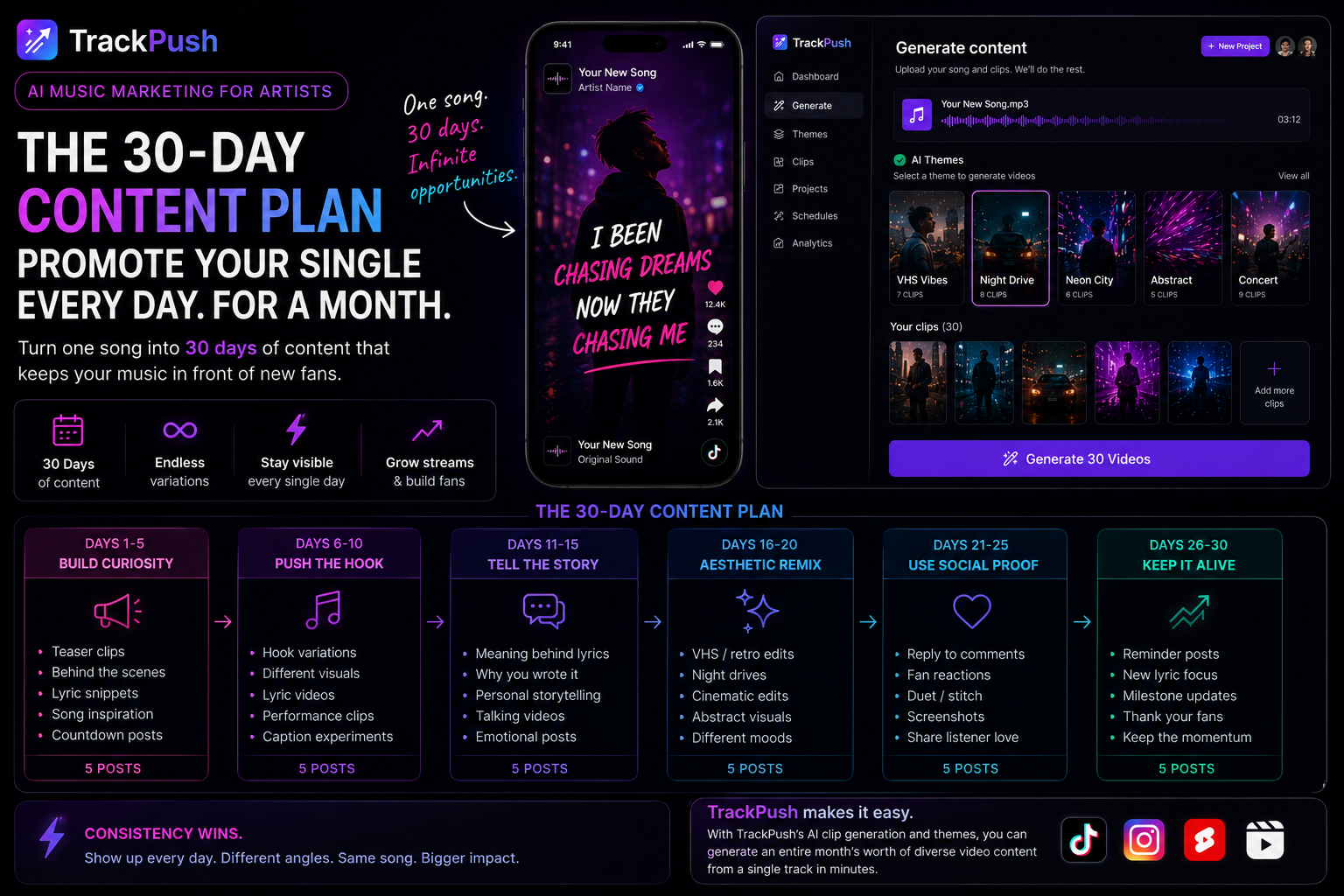
Releasing a song is exciting.
But once the song is out, the real challenge begins:
How do you keep promoting it without annoying people, repeating yourself, or burning out?
Most artists make the same mistake. They spend weeks or months creating a single, post about it once or twice, then move on. But social media does not work that way anymore.
TikTok, Instagram Reels, and YouTube Shorts reward consistency. One post is not enough to build momentum. One announcement is not enough to make people care. One video is not enough to find the right audience.
If you want your song to have a real chance, you need a content plan.
That is why more artists are searching:
“How to generate bulk content to post and promote my song”
Because they know they need more than one promo clip.
They need a system.
Why One Song Needs 30 Days of Content
A lot of artists feel awkward promoting the same song over and over.
But the truth is, most of your audience does not see every post.
Someone might miss your release announcement.
Someone might scroll past the first video.
Someone might only connect with the lyric after hearing it several times.
Someone might discover the song through a different visual, hook, or caption.
That is why repetition matters.
You are not bothering people by promoting your song multiple ways. You are giving the song multiple chances to connect.
One single can become:
- Lyric videos
- Behind-the-scenes clips
- Studio footage
- Performance edits
- POV videos
- Aesthetic visuals
- Fan reaction posts
- Storytelling videos
- Hook-based TikToks
- Instagram Reels
- YouTube Shorts
- Countdown posts
- Release day clips
- Post-release reminders
The song stays the same.
The angle changes.
That is how you keep the campaign fresh.
The Problem: Artists Need High-Volume Content
The modern music algorithm rewards content volume.
That does not mean posting random low-quality videos.
It means creating enough versions of your song to test what actually works.
One video might fail because:
- The first second was too slow
- The caption was weak
- The visual did not match the song
- The lyric was not the strongest part
- The platform showed it to the wrong audience
But another version of the same song could perform much better with a different hook, clip, or emotional angle.
This is why major labels create so much content around every release.
They do not rely on one post.
They build campaigns.
Independent artists need the same mindset, just with a faster workflow.
The 30-Day Music Promo Framework
Here is a simple way to turn one song into 30 days of social content.
Days 1-5: Build Curiosity Before the Release
Before the song drops, your goal is not to sell.
Your goal is to create curiosity.
Post content that makes people wonder what is coming.
Content ideas:
- A short clip of the strongest lyric
- A behind-the-scenes studio moment
- A video explaining what inspired the song
- A teaser with no full hook yet
- A “this song is for anyone who…” post
Example captions:
- “I wrote this for the people who act like they moved on but still remember everything.”
- “This one hurt to make.”
- “I almost did not release this.”
- “This lyric explains the whole song.”
The goal is emotional setup.
You want people to feel connected before the song is even out.
Days 6-10: Push the Main Hook
Once the song is released, focus on the strongest part of the track.
This could be:
- The chorus
- The beat drop
- The most emotional lyric
- The catchiest phrase
- The most relatable line
Create multiple videos using the same hook but different visuals.
For example:
- Hook over studio footage
- Hook over night drive footage
- Hook over performance footage
- Hook over lyric captions
- Hook over lifestyle clips
Do not assume one version is enough.
Test different styles.
Days 11-15: Tell the Story Behind the Song
Now that people have heard the hook, give them context.
People connect with stories.
Post content about:
- Why you wrote the song
- What the lyric means
- What emotion inspired it
- What moment in your life created it
- What you want listeners to feel
This works especially well for emotional songs, breakup songs, motivational songs, and personal records.
You can use talking videos, text overlays, or simple lyric edits.
Example post ideas:
- “The real story behind this lyric”
- “I wrote this after realizing…”
- “This song is about pretending you are okay when you are not”
- “If you ever had to let someone go, this one is for you”
Days 16-20: Repurpose With Different Aesthetics
This is where most artists stop too early.
Instead of only using one visual style, remix the song into different aesthetics.
Try:
- VHS edit
- Night drive edit
- Cinematic edit
- Concert edit
- Abstract visual edit
- Sad lyric edit
- High-energy performance edit
- POV relationship edit
Different aesthetics attract different audiences.
Someone who ignores a studio clip might save a night-drive lyric edit.
Someone who skips a lyric video might engage with a cinematic performance clip.
The more versions you test, the more data you get.
Days 21-25: Turn Comments and Reactions Into Content
If people comment on your posts, use those comments as content.
This is one of the easiest ways to extend a campaign.
Turn comments into:
- Reply videos
- “People are feeling this lyric” posts
- Reaction clips
- Fan reposts
- Story screenshots
- Follow-up edits
Even a simple comment like “this lyric hit me” can become a new post.
This makes your audience feel involved in the release.
It also shows social proof.
Days 26-30: Keep the Song Alive
The final stretch is about reminding people without sounding repetitive.
Use content like:
- “If you missed this song…”
- “This one is still growing”
- “The lyric people keep replaying”
- “This song is for anyone who…”
- “One month later and this line still hits”
Most artists stop pushing after release week.
That is a mistake.
A song can keep growing for weeks or months if you keep creating content around it.
A Simple 30-Day Content Breakdown
Here is an easy structure:
- 5 teaser posts
- 5 hook-focused videos
- 5 lyric videos
- 5 behind-the-scenes posts
- 5 aesthetic edits
- 3 comment/reaction posts
- 2 reminder posts
That gives you 30 pieces of content from one song.
You do not need to reinvent the wheel every day.
You just need different angles.
What Makes the Content Actually Work?
Posting more only helps if the content is built correctly.
Strong music promo videos usually include:
1. A Fast Opening
The first 1-2 seconds matter.
Start with the strongest visual or lyric immediately.
Do not waste time with slow intros.
2. Clear Captions
Captions help people understand the song faster.
They also keep viewers watching longer, especially when the lyric is emotional or relatable.
3. A Strong Emotion
People share music content when it makes them feel something.
That feeling could be:
- Heartbreak
- Confidence
- Nostalgia
- Energy
- Motivation
- Anger
- Hope
The clearer the emotion, the easier it is for people to connect.
4. Multiple Versions
Do not rely on one video.
Create several versions of the same hook.
Change the background, caption, clip order, or aesthetic.
Sometimes the smallest change can make a video perform better.
5. Consistent Posting
A campaign works best when people keep seeing the song.
Posting once every few weeks is not enough.
A steady 30-day plan gives the algorithm more chances to find the right audience.
How TrackPush Helps Create 30 Days of Music Promo Content
The hardest part of a 30-day content plan is not the strategy.
It is the editing.
Most artists do not have time to manually create 30 videos in CapCut.
That is where TrackPush helps.
TrackPush lets artists upload a song, add clips, choose themes, and generate multiple short-form video variations quickly.
With TrackPush’s AI clip generation and themes, you can generate an entire month’s worth of diverse video content from a single track in minutes.
Instead of manually syncing clips, typing captions, and exporting one video at a time, TrackPush helps automate the heavy lifting.
You can create:
- Lyric videos
- Beat-synced edits
- Aesthetic promo clips
- TikTok videos
- Instagram Reels
- YouTube Shorts
- Multiple versions from one song
- Different theme-based edits
This makes it easier to stay consistent without spending every day editing.
Why Independent Artists Need Systems
The artists who grow online are not always the artists with the most money.
They are often the artists with the best systems.
A good content system helps you:
- Post consistently
- Test more hooks
- Save time
- Avoid burnout
- Promote longer
- Stay visible
- Build fan recognition
Your song needs repetition to grow.
Your content system makes that repetition manageable.
Final Thoughts
A single release should not be treated like one post.
It should become a 30-day campaign.
The more content you create around a song, the more chances you give it to reach the right listeners.
You do not need to spend hours editing every day.
You need a repeatable workflow that turns one song into multiple short-form videos across TikTok, Instagram Reels, and YouTube Shorts.
TrackPush helps artists do exactly that by turning one track and a few clips into a full month of music promo content, giving independent musicians a faster way to stay consistent, grow their audience, and focus more on making music.
Content framework versus release calendar
This guide focuses on building a reusable content framework around one single: the hooks, visuals, stories, reactions, and variations that keep the campaign from becoming repetitive. If you need a date-by-date schedule organized around the weeks before release, release week, and the weeks after launch, use the 30-Day Song Release Content Calendar for Independent Artists. The two guides work together: use the calendar to decide when to post and this framework to decide what kind of content to make.
<h2>Plan the full life of your next release</h2>
<p>A content calendar works best when each stage has a clear job. Use the <a href="/blog/how-to-promote-an-unreleased-song">unreleased song promotion guide</a> before launch, the <a href="/blog/what-to-post-on-release-day-for-a-song">release day posting plan</a> when the track goes live, and the <a href="/blog/what-to-post-after-releasing-a-song">post release content guide</a> to keep finding new creative angles.</p>