Release Strategy · 9 min read ·
The 30-Day Song Release Content Calendar for Independent Artists
A simple 30-day content calendar artists can use to promote a release before, during, and after launch without running out of things to post.
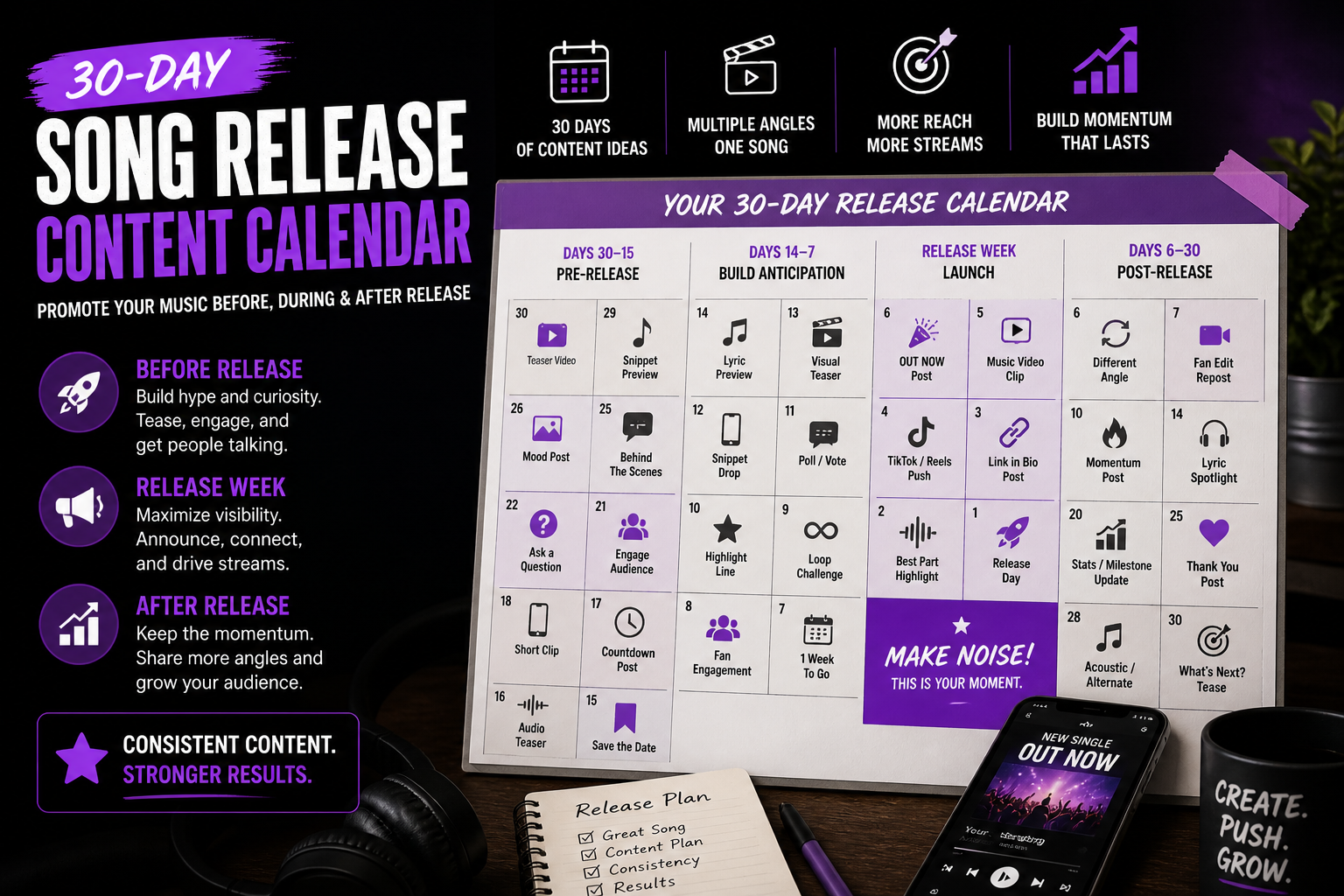
A song release should not live for one day.
Too many artists spend weeks finishing a song, uploading it, and preparing the artwork, only to post once or twice when it goes live. Then the momentum disappears.
The problem usually is not lack of effort. It is lack of a clear content structure.
If you want a release to have a real chance, you need a plan for:
- before the song drops
- when the song drops
- after the song drops
This 30-day song release content calendar gives you a simple framework you can reuse for every release.
Why most releases lose momentum fast
Most songs do not fail because the music is bad.
They fail because:
- the artist posted too little
- the artist repeated the same content angle
- the artist stopped pushing too soon
- there was no post-release plan
A strong release campaign keeps the song visible across multiple weeks, not just release day.
The 3 phases of a release campaign
Phase 1: Pre-release
This is where you build curiosity and familiarity.
Your goal is not to explain everything. Your goal is to make people:
- notice the song
- remember the snippet
- feel the mood
- anticipate the drop
Phase 2: Release week
This is where you convert attention into action.
Now the messaging becomes clearer:
- out now
- streaming everywhere
- link in bio
- use the sound
- watch the full version
Phase 3: Post-release
This is where you keep the song alive.
This phase matters because most people do not react on release day. They need multiple reminders and new angles before they engage.
Days 30 to 15 before release
This is the early awareness phase.
Post ideas:
- teaser visuals with no hard CTA
- cryptic lyric fragments
- aesthetic mood edits
- studio moments
- short snippet reveals
- “something’s coming” posts
What matters here:
- do not over-explain
- focus on mood
- build recognition around the snippet
You want the song to start feeling familiar before the official release.
Days 14 to 7 before release
Now the song should become more recognizable.
Post ideas:
- lyric previews
- stronger hook moments
- repeat the best snippet in different visual styles
- fan-edit style content
- early countdown posts
- “pre-save now” if relevant
This is where repetition starts helping you.
If someone saw the snippet once and ignored it, the second or third version may be the one that gets them.
Release week
This is the most visible phase, but it should not all look the same.
Content types to use
- direct “out now” videos
- lyric-led posts
- strongest hook snippet
- fan-edit style organic content
- post with title/artist overlay
- story behind the song
- repost reactions if available
Best rule for release week
Do not post one version five times.
Post five different angles around the same song.
That keeps the campaign fresh while still reinforcing the same release.
Days 6 to 30 after release
This is where many artists stop too early.
But this is one of the best times to keep pushing because:
- the pressure is lower
- you can experiment more
- you already know which snippet feels strongest
- you can reframe the song in new ways
Post ideas:
- hidden gem angle
- “you missed this” angle
- strongest lyric spotlight
- mood-based edits
- drop highlight
- fan-style repost edits
- comments/reaction style prompts
- alternate hooks
This phase is where the song can still pick up momentum from repetition.
A simple weekly posting rhythm
A practical structure looks like this:
Week 1
- 2 teaser posts
- 2 mood/aesthetic posts
- 1 lyric preview
Week 2
- 2 stronger snippet posts
- 2 lyric-led posts
- 1 countdown or anticipation post
Week 3 (release week)
- 2 direct out-now posts
- 2 fan-edit style posts
- 2 hook-first posts
- 1 lyric post
Week 4
- 2 mood reworks
- 2 “you missed this” posts
- 1 strongest-line spotlight
- 1 high-energy highlight
- 1 reminder CTA
That gives you steady visibility without needing completely new ideas every day.
How to avoid running out of content
The answer is not more songs.
It is more angles.
One release can become many pieces of content if you vary:
- hook text
- pacing
- lyric emphasis
- CTA
- visual order
- promo mode
That is how one song turns into a full campaign.
How TrackPush helps with this workflow
TrackPush makes this easier by helping artists generate multiple short-form promo videos from:
- one song snippet
- one visual theme
- one set of clips
That means instead of editing every post manually, you can create enough content for the full release cycle much faster.
You can use different promo styles for the same song, including:
- teaser
- lyric push
- fan edit
- out now
- drop highlight
That gives you the flexibility to support the full 30-day calendar.
Final thought
A release is not one moment. It is a sequence.
If you want your music to stay visible, you need content before the release, during the release, and after the release.
The artists who stay consistent usually win more attention than the artists who post once and disappear.
Build your release like a campaign, not an announcement.
And if you want to create that campaign faster, TrackPush helps turn one song into weeks of short-form promo content.
<h2>Plan the full life of your next release</h2>
<p>A content calendar works best when each stage has a clear job. Use the <a href="/blog/how-to-promote-an-unreleased-song">unreleased song promotion guide</a> before launch, the <a href="/blog/what-to-post-on-release-day-for-a-song">release day posting plan</a> when the track goes live, and the <a href="/blog/what-to-post-after-releasing-a-song">post release content guide</a> to keep finding new creative angles.</p>