Content Strategy · 11 min read ·
Short-Form Music Content Strategy for Independent Artists With No Marketing Team
A practical short-form strategy for solo artists: batch lyric videos, test hooks, post consistently, and grow without a marketing team.
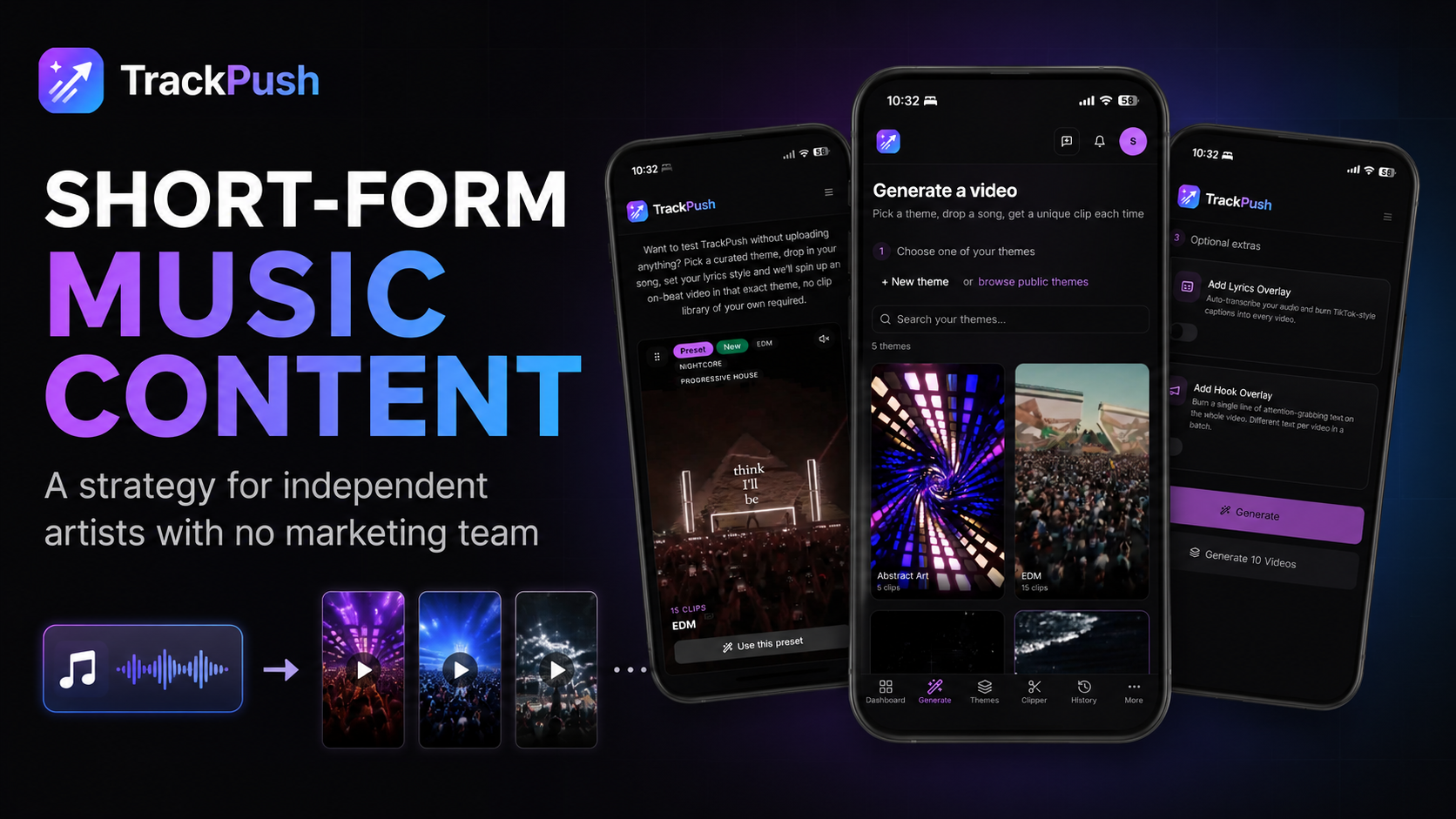
If you are an independent artist with no marketing team, your short-form strategy should be simple: choose one song, build a small library of reusable visuals, create several hook-and-lyric variations in one session, and post them as tests across TikTok, Instagram Reels, and YouTube Shorts.
You do not need to become a full-time content creator. You need a repeatable system that keeps your music visible while leaving enough time to make the music.
This guide gives you that system. It is designed for the artist who is also the songwriter, editor, social media manager, designer, and release team.
The real job of short-form content
Short-form music content has three jobs:
- Discovery: give a stranger a reason to stop and hear part of your song.
- Connection: help the right listener understand the emotion, story, or personality behind it.
- Action: invite an interested viewer to save the song, visit your profile, follow, comment, or listen elsewhere.
One post does not need to do all three perfectly. A lyric video may introduce the emotion. A studio clip may make the artist feel real. A direct-to-camera post may explain the story. Together, those posts create a campaign.
That is a healthier goal than trying to make every upload go viral. No content format guarantees views. Your advantage as an independent artist is the ability to test ideas quickly, notice what people respond to, and make the next post more specific.
Build a one-person content engine
A solo artist does not have time to invent a new concept every day. Build three reusable banks instead.
1. Your song-moment bank
Choose four to six moments from the same song:
- The most memorable chorus line
- A lyric that works as a confession or quote
- The emotional turn in the pre-chorus
- A beat drop or instrumental switch
- A line that raises a question
- A moment fans could use in their own videos
Do not automatically choose the part you spent the most time producing. Choose the part a new listener can understand fastest.
Read each lyric without the music. “My new song is out now” asks the viewer to care about you first. A line such as “I still check the door like you might come back” gives the viewer a feeling immediately.
2. Your visual bank
Collect 10 to 20 short vertical clips that belong to the same visual world. They can include:
- Performance footage
- Studio moments
- Night drives or city scenes
- Tour, rehearsal, or backstage clips
- Close-ups and everyday details
- Abstract visuals that match the sound
- Licensed stock footage you are allowed to use
The clips do not need to tell a complete story. They need to share a mood. Think of the library as a Pinterest board for video.
TrackPush turns this kind of visual library into a reusable theme. You can build your own or browse public TrackPush themes, then reuse that look with different parts of your song.
3. Your hook bank
Write 10 short lines that can introduce the song from different angles. For example:
- “I wrote this after pretending I was over it”
- “The lyric I almost deleted”
- “For anyone who misses the person they had to leave”
- “Would you send this to them?”
- “POV: you take the long way home to avoid their street”
- “This part sounds different at 2 a.m.”
A hook overlay is not the same as the lyric. The hook gives context; the lyric delivers the emotion. If the lyric is already clear and interesting, let it open the video by itself.
TikTok’s official creative guidance emphasizes communicating the idea early and using text overlays for context. Although its guidance is written for advertisers, the principle is useful for artists too: make the opening understandable before asking for attention. See TikTok’s creative best practices.
A 90-minute weekly workflow
Instead of editing every day, protect one weekly content session.
Minutes 0–15: choose this week’s objective
Pick one goal:
- Introduce a new song to people who do not know you
- Test which lyric connects most
- Build anticipation before release day
- Give existing listeners more context
- Send interested viewers to the full track
This keeps the week focused. If the goal is discovery, prioritize immediate hooks. If the goal is connection, tell more of the story. If the goal is conversion, make the song title and next step easy to find.
Minutes 15–30: choose the variables
Select:
- Two song moments
- Two visual directions
- Three hook lines
You now have multiple combinations without filming multiple campaigns.
Minutes 30–60: generate the batch
In TrackPush, choose a theme, upload the song, select the section, and add the lyric or hook overlay. Generate several versions instead of rebuilding the edit on a timeline.
Change one main variable at a time:
- Same lyric, different visual
- Same visual, different hook
- Same hook, different song section
- Same concept, shorter opening
Controlled variations teach you more than five completely unrelated posts. You can make short lyric videos with TrackPush and keep the creative decision-making while removing repetitive editing work.
Minutes 60–75: quality check
Before publishing, check every video on your phone:
- Are the lyrics accurate?
- Can the text be read without pausing?
- Is important text clear of platform buttons and captions?
- Does the first frame make sense?
- Is the song title easy to find on your profile or caption?
- Do you have permission to use every visual and audio element?
Automatic transcription is a starting point, not the final editor. Always correct names, slang, ad-libs, and stylized pronunciation.
Minutes 75–90: schedule and document
Give each post a purpose and save it in a simple note or spreadsheet:
Post · Format · Variable being tested · Goal
1 · Lyric-first · Chorus A · Discovery
2 · Story hook + lyric · Hook B · Connection
3 · Mood visual · Theme C · Discovery
4 · Studio clip · Personal context · Connection
5 · Best variation reposted natively · Platform caption · Action
Do not upload five versions at once. Spread them across the week so each post gets a fair test and your audience sees variety.
Five content formats one artist can sustain
Lyric-first video
Open directly on the strongest line. Use a clear visual and readable synced words. This is the easiest repeatable format because the song supplies the story.
Story-before-song video
Lead with one sentence about the real moment behind the lyric, then let the song answer it. Keep the explanation specific. “I wrote this after she left” is less interesting than “I wrote this after seeing her car outside the place we used to go.”
Performance fragment
Record one take of yourself singing, producing, playing, or reacting to the track. It does not need a full set or camera crew. A human face gives the campaign a different texture from visual edits.
Mood edit
Pair the song with a visual world that makes the listener feel something before they understand every word. This works especially well for instrumentals, electronic music, and atmospheric sections.
Audience prompt
Ask a question connected to the song:
- “Which line should be the caption?”
- “Would you keep this verse?”
- “What scene does this sound like?”
- “Does the first or second hook hit harder?”
The question should help you learn, not merely ask for engagement.
A realistic seven-day posting plan
Here is a sustainable starting cadence:
Day · Post
Monday · Strongest lyric, no extra hook
Tuesday · Behind-the-song story
Wednesday · Same lyric with a different visual theme
Thursday · Performance or studio fragment
Friday · Different song moment with a question
Saturday · Best concept adapted for another platform
Sunday · Review results and prepare the next batch
Posting daily is optional. Three strong posts per week can be more sustainable than seven rushed ones. The system matters more than an arbitrary streak.
Instagram says Reels is a place for people to create, share, and discover video, and its current creator guidance gives original creators priority in recommendations. That makes your own performance, story, lyrics, and visual treatment more valuable than simply reposting another account’s content. Read Instagram’s original-content guidance.
YouTube currently categorizes square or vertical videos up to three minutes as Shorts, but maximum length is not a target. Use the shortest version that completes the idea. YouTube also warns that Shorts longer than one minute with an active Content ID claim can be blocked globally, which matters for artists and collaborators using distributed music. Review YouTube’s three-minute Shorts guidance before publishing longer edits.
Measure the signal, not just the view count
Views tell you how far a post traveled. They do not tell you everything about whether it found the right listeners.
Match the metric to the post’s job:
Goal · Useful signals
Discovery · View duration, completion, rewatches
Connection · Comments, shares, saves
Artist growth · Profile visits, follows
Song action · Sound-page visits, link clicks, streams where measurable
Compare related posts. If the same lyric performs better with a night-drive theme than a studio visual, keep testing that mood. If a story hook earns fewer views but more profile visits, it may still be the more valuable post.
Write down one lesson each week. After a month, you should know more about your audience than you did when you started.
What not to automate
Automation should remove repetitive production, not remove the artist.
Keep these parts human:
- Choosing the lyric that matters
- Explaining the real story
- Proofreading the words
- Replying to meaningful comments
- Deciding what your visual identity feels like
- Judging whether a trend fits your music
TrackPush can assemble clips, sync visuals to the song, add captions, and create variations. It cannot replace your point of view—and it should not.
Common mistakes solo artists make
Trying to market every song at once
Focus on one song long enough to learn which moments connect. Constantly switching tracks resets the experiment.
Making every post a release announcement
“Out now” is a call to action, not a content idea. Lead with the lyric, feeling, conflict, or story first.
Rebuilding every edit from scratch
Reuse the visual bank, caption style, and proven hook structure. Consistency is a brand asset, not laziness.
Changing everything between tests
If the song moment, hook, visual, length, and caption all change, the result cannot tell you which choice mattered.
Copying trends that do not fit
Use trends as storytelling structures, not costumes. A recognizable format can help the viewer understand the post, but your song and personality still need to belong in it.
Frequently asked questions
How often should an independent artist post short-form content?
Start with a cadence you can sustain for at least four weeks. Three to five posts per week is a practical test for many solo artists, but quality, learning, and consistency matter more than a universal number.
Do I need different videos for TikTok, Reels, and Shorts?
You can begin with the same clean vertical master, then adapt the caption, text-safe areas, sound selection, and call to action for each platform. Upload natively rather than downloading a version with another platform’s watermark.
What should I post if I have no music video?
Use phone clips, studio footage, performance fragments, licensed stock visuals, abstract loops, or a reusable TrackPush theme. A strong lyric and coherent mood can carry the post without a traditional music video.
Can lyric videos help an artist get more views?
They can make a song easier to understand and give viewers a phrase to remember or share, but they do not guarantee reach. Treat them as a repeatable testing format.
How can I avoid content burnout?
Batch production once a week, reuse visual systems, keep an idea bank, and separate creation from posting. Reduce the number of decisions required each day.
Your marketing team can be a system
You may not have a social media manager, video editor, or label campaign. You can still operate with a clear process:
- Choose one song
- Build your moment, visual, and hook banks
- Generate controlled variations
- Post them across the week
- Measure the signal that matches the goal
- Carry one lesson into the next batch
Start creating short-form music videos with TrackPush and turn one song into a week of lyric, hook, and visual tests without rebuilding every edit by hand.